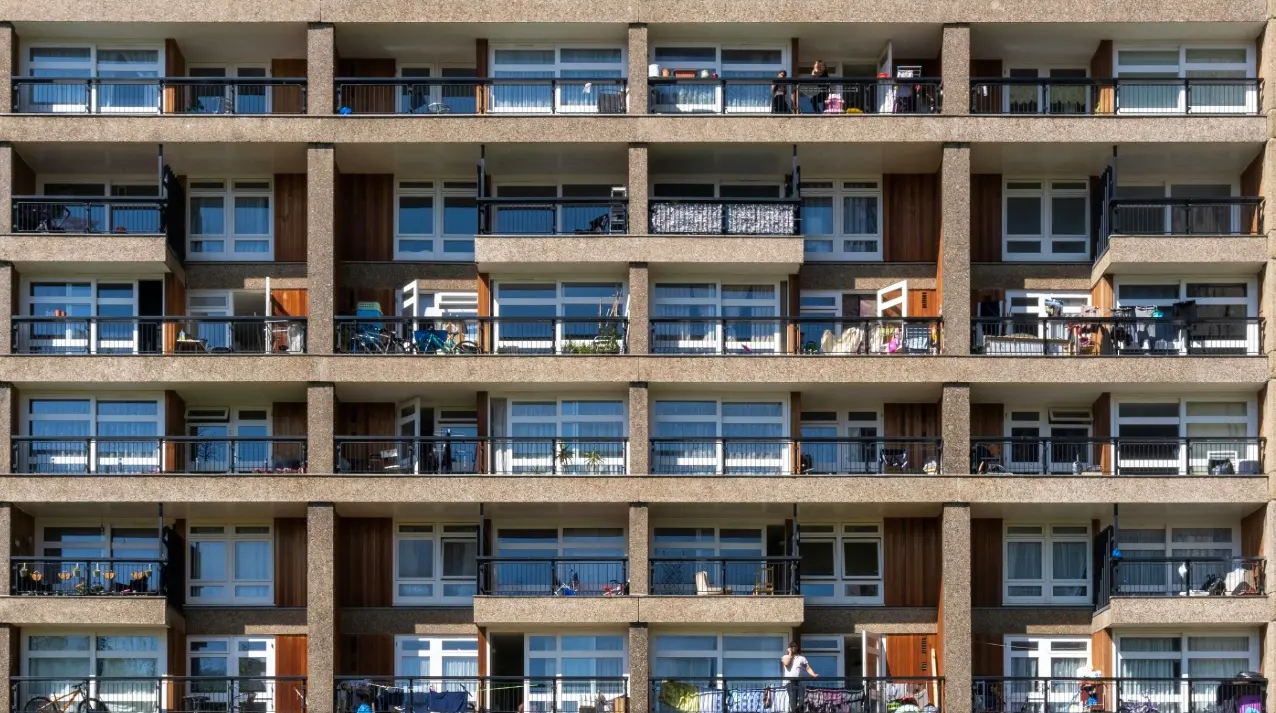
The problem of housing availability in Poland is significant. Even the ruling coalition politicians and the opposition do not deny it. It turns out that the situation, which has been difficult in recent years, is gradually becoming dramatic. Renting is getting more expensive, and Polish wages are growing too slowly. Compared to the European average, Poles are in a very difficult position, as they must spend half or more of their income on renting an apartment. The European average is much lower. It is between 25 and 30% of income for a home in Western Europe – Tomasz Błeszyński, real estate market advisor, calculates.
In Poland, depending on the apartment and income, it can be from 40% up to 75% of salary.
Against Europe, Poland fares increasingly poorly in the "income – housing cost" ratio. Not because apartments are exceptionally expensive in absolute terms, but because wages are not keeping pace with the rate of living cost increases in cities.
The most striking conclusion is simple: in Poland the problem is no longer the number of available apartments, but their real financial affordability. Renting is still possible, but increasingly at the expense of life stability” – emphasizes Tomasz Błeszyński.
Read also: Are real estate prices in Poland high and only high? In these cities you can still buy apartments below 10,000 PLN per square meter
Renting an apartment in Poland consumes most Polish salaries
The cost of renting an apartment in Poland keeps renters awake at night. The problem does not only affect the lowest earners, but also the so‑called middle class, which is too wealthy to apply for a public housing unit, and too poor to afford buying a home.
In 2026 in Poland renting a studio costs on average between 2,500 and 3,300 PLN (including fees). For a two‑room apartment the average is much higher, from 3,400 to 4,400 PLN (including fees). That is more than the minimum wage in our country, which from 2026 will be about 3,606 PLN net. This shows that the lowest earners, especially if they are singles, cannot afford a larger unit.
Those earning a bit more can do so. But their situation is also difficult. The average salary in Poland in the enterprise sector in 2026 is about 9,000 PLN gross, i.e. almost 6,500 PLN net. Note that this is an average that has little to do with real Polish earnings. The median is clearly lower, meaning that a large portion of Poles earn real wages between 4,500 and 5,500 PLN net.
For an average worker, renting an apartment is no longer a neutral budget item, but one of the main factors limiting quality of life. In many cases it consumes half or more of income, automatically pushing other needs to the back burner – savings, investments, and often financial security” – notes Tomasz Błeszyński, real estate market advisor.
As the real estate advisor adds, the most expensive are Warsaw, Kraków and Wrocław, but price pressure now also covers medium‑size cities.
As Tomasz Błaszczyński calculates, with an income of about 6,300 PLN net per month – which, as we noted, is already far more than most Poles earn – renting a studio consumes about 45% of salary, while a two‑room apartment consumes 60% of receipts!
With a salary of 5,000 PLN net (which is still a high salary considering Polish realities) renting a studio can consume more than 50% of salary, and a two‑room apartment even 70‑75% of income.
“The most alarming fact is that the problem does not only affect the lowest earners. It increasingly also includes people working full time, with education and stable employment – the classic middle class. This is the group that is now in the most difficult position – too “wealthy” for system support, but too “poor” to enter the ownership market.
As a result, a structural trap emerges: renting becomes not a transitional stage, but a permanent state. And that means long‑term social consequences – delayed family decisions, less capital mobility and increasing sense of financial pressure despite full‑time work” – notes Tomasz Błeszyński, real estate market advisor.
Because of high rents, Poles can afford less and less
High rents mean that Poles can save less and less money, if they can at all. With rent expenses of 2,500–3,000 PLN for a single or 4,000–5,000 PLN for a couple, considering income and other expenses, it may turn out that a monthly attempt to save money ends in failure.
As Tomasz Błeszyński calculated, a single earning 6,300 PLN net (again, a high income for Polish conditions) spending 2,900 PLN on housing and 2,700 PLN on living can save only 700 PLN per month.
This is not a safety buffer. It is a margin of error” – emphasizes the real estate advisor.
The situation looks better for a couple, who together with such earnings have an income of 12,600 PLN (this is, of course, a purely theoretical situation, as it is rare for partners to have the same earnings, in this case at a fairly high level). Then, spending 3,800 PLN on housing and 4,500 PLN on living, they could save about 4,300 PLN per month.
See also: Ambitious plans or empty declarations? The government’s housing strategy for 2026