









UK inflation was undoubtedly hot in July, but as ever, the devil lies in the detail.
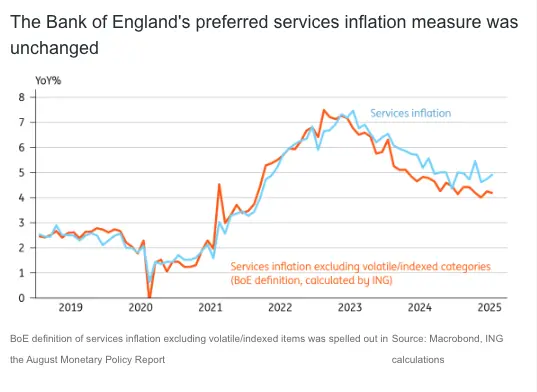
Services inflation – the bit usually most relevant for the Bank of England – rose to 5% from 4.7%. That was enough to drag core inflation up slightly too. But this was overwhelmingly down to a larger-than-usual rise in airfares. These are particularly volatile in July, depending partly on when the survey date falls relative to the start of school holidays. Interestingly, hotel prices – which many expected to surge amid Oasis’ tour dates – barely increased on the month.
These are things the Bank of England can safely ignore. We calculate the Bank’s preferred measure of services inflation, excluding volatile/indexed categories, to be essentially flat in annual terms. And at 4.2%, this measure is a fair bit below overall services inflation.
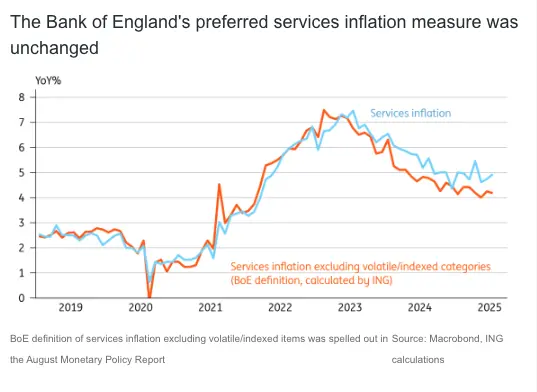
But that doesn’t mean the central bank will relax entirely. Officials are keeping an unusually keen eye on food inflation right now. And this picked up further to 4.9%, from 2% at the end of last year. The Bank expects it to rise above 5% by year-end.
We suspect it’s interested in this for two reasons:
First, because there is a loose correlation between supermarket and restaurant prices. And those restaurant/cafés make up 40% of that services inflation measure which excludes volatile/indexed items. Catering inflation is indeed running a little hotter, presumably linked to payroll tax and National Living Wage hikes back in April.
Secondly, food prices are seen as an important driver of household inflation expectations. And some BoE officials worry that, with headline inflation close to 4%, there’s a risk that these expectations become less anchored.
We think these concerns are overblown, not least because the cooling jobs market should exert further downward pressure on wage growth in the second half of 2025. And when it comes to services, we think inflation will be a little more benign than the BoE’s forecasts predict. Partly that’s because rental inflation should slow considerably as the year progresses; we saw more signs of that in July’s data, on account of less aggressive social rent rises.
That all leads us to think a November rate cut is still more likely than not, though it’s not a particularly high conviction call right now given the very evident division on the rate-setting committee. Much also hinges on the jobs market, where employment has fallen in eight out of the past nine months, but where the survey data is looking a little less worrisome than it did earlier this year.
For now, we expect a rate cut in November to be followed by two further moves next year.